Besides the obvious answer of "diapers," what do you need to get started cloth diapering? Really, just the diapers and a way to wash them is all that's necessary. Oh, and a baby to put them on! Otherwise we get into creepy adult diaper fetish territory, and no one wants that. I hope.
There are, however, many things that will make your life easier. (This is accessories only: diapers, inserts, and covers are not included here.)
Small wetbags:
1-2 small wetbags for the diaper bag/going out. Two is nice so you have one available while one is in the wash but not necessary.
Diaper pail:
A place to store dirty diapers. You can get a special diaper pail, but really all you need is a trash can with a lid. The more air circulation, the less smell, so a swing-top lid is a good bet.
AND
Pail liner:
1-2 pail liners. Two is nice so you have one available while one is in the wash, but not necessary. You put the pail liner in the trash can or diaper pail. It allows you to transfer the dirty diapers to the washer without having to touch any dirty diapers (just turn it inside out into the drum of the washer), and can help contain smells.
--OR--
Large Wetbags:
1-2 large wetbags. In lieu of a diaper pail and pail liner, some people use large (usually hanging) wetbags. Either option is fine and is totally personal preference.
Doublers:
It's always nice to have a handful of doublers to add extra absorbency in a pinch, but they may not be needed. OPTIONAL
Liners:
Disposable liners can make solid poop a breeze to flush; however, some older septic systems will clog with disposable liners, so be careful. Fleece liners will add a stay-dry feeling to any diaper that doesn't already have one, and can be used to protect diapers if you have to use a non-cloth diaper safe diaper cream (wash separately with clothes after use). How many? It depends on how often you are going to use them! Disposable liners usually come in large packs that you'll replace as you use them. Fleece liners can be used every diaper change (for instance, if you use prefolds and always want a stay-dry feeling) or rarely, just when you need to use a special diaper cream. So how many you need depends on your anticipated use. OPTIONAL
Cloth wipes:
24-36+ wipes. You're already doing cloth diapers, might as well do wipes too! (But for real: they get so much more off than disposable wipes, and you are far less likely to get poop on you wiping with cloth!) Also: wipe solution. Technically these are optional but I highly recommend making the switch! There are a lot of ways to use these - some people fill a peri bottle with solution, some people have a small spray bottle, some people have container of solution that they keep pre-moistened wipes in. Some people spray the wipes; some people spray the baby's bottom. While on the go, some people will take a baggie of wet wipes and some people will take dry wipes and the spray bottle. Whatever works for you is the right way!
Snappis:
2-3 Snappies. Only needed if using flats, prefolds, or snapless fitteds to secure the diapers. Not needed otherwise. (You could also use old-fashioned diaper pins.) OPTIONAL
Cloth-diaper safe rash cream:
This can be used as a preventative, to make cleaning poop off easier (hint: it doesn't stick as much to the baby!), and to clear up rashes. CJ's BUTTer is a popular option, as is plain coconut oil.
Diaper sprayer:
Used to spray off solid poop into the toilet, where it can be flushed. However, you don't need this until your child has started solids at about six months of age. Some people opt to skip the sprayer and instead "swish" or "swirl" their diapers in the toilet (hold the diaper in the water and flush the toilet) or to scrape their diapers (using a designated spatula to scrape the poop into the toilet). Some kids grace their parents with poop that immediately can just be "plopped" into the toilet and no spraying, swishing, or scraping is necessary! OPTIONAL
Cloth-diaper safe detergent:
Don't ruin your diapers! Use a detergent that is safe for cloth diapers.
Line dryer:
Somewhere to dry your diapers outside, preferably in the sun. Get out stains and lengthen the life of your diapers! Also: clothespins. OPTIONAL

Thursday, January 26, 2012

Tuesday, January 17, 2012
Guest Post : Kristen from "A Tale of Two Babies."
Kristen is the mother of two absolutely BEAUTIFUL baby girls, and she cloth diapers them! Some people say they can't imagine cloth diapering twins, but Kristen always says she can't imagine NOT cloth diapering twins! Check out Kristen's life (and her amazing nursery) at A Tale of Two Babies.
_______________________________________


I have wanted to sit down and write out this post for a while! There is just so much I want to put in this, so please bear with me as it will most likely turn into a novel! There are lots of resources for cloth diapering on the web, but as far as I know, there aren't many that are specifically dedicated to cloth diapering multiples. When I was pregnant, I had a lot of CD (cloth diaper) related questions that were twins related. Such as) how many do you need for twins? What brand works best? Since I'll need double, what are some brands that are less expensive? What is the washing/care routine?
Twins are obviously more work than having one baby. So you might think that adding in cloth diapers is an unnecessary burden. However, I find it to be just as easy, if not easier, than using disposables. Once you get a good routine down, CDing is easy, fun and a GREAT way to save money!
How many cloth diapers do I need, and what is this going to cost me?
This was a question I asked over and over when I was pregnant. To be honest, I only started with a few, then added to my stash as time went on and I figured out what worked for me the best. In addition, Miss Catherine and Miss Emily were born on the small side (5 lbs and 5 lbs 3 oz) so they couldn't fit into most one-size diapers when they were still tiny newborns. During the first month we used preemie sized prefolds and covers along with disposables (we got a few packs of disposables as gifts from my showers). But anyways, here is the breakdown of how many diapers I have currently.
2 - Kawaii Goodnight Heavy Wetter (snaps)
4 - Kawaii One Size Fun Prints (snaps)
2 - Blueberry Minky's (velcro)
6 - Sunbaby's (snaps)
2 - Fuzzibuns (snaps)
26 - Kawaii Pure & Natural (velcro)
So that is a total of 42 diapers that I use daily. And, thanks to the internet, I know exactly how much I've spent: $372.57. However, my mother in law graciously bought me 10 diapers for Christmas so if you subtract $73 for those, it equals $299.57.
(I also have some preemie and normal sized prefolds and covers, but my mom bought me those so I didn't count them in my total. Plus I pretty much only use them if all my diapers are in the wash, which is rare, or for burp cloths and rags!)
So let's do the math here, shall we? My girls are 29 weeks old. Let's figure that I use 10 diapers per day, per baby. So a total of 20 diapers a day, 140 diapers per week. That is 4,060 diapers that I would have used since they have been born (and we all know that as newborns, and once you start solids, you use more than 10 diapers per day!). So let's say I was using super cheap disposables - parent's choice from walmart. Online, it states that a pack of 200 diapers is $23.88. That means I would have spent $484.76 by now! So that is a savings of $185.19 AND my girls are only 6 months old! And if I used a more expensive brand, like Pampers for example, I would have spent a total of $922.42 by now!!! That is a savings of $622.85!!! These diapers will get them well into potty training so now every month I use cloth over disposables, I'm saving money. Yes cloth is an initial investment, but over time you easily make back what you would have spent on disposables. Plus, you NEVER have to run out to the store because you're "out of diapers". With cloth, all you have to do is run a load of laundry!
In addition, all of these diapers are "pockets." That means there's a "shell," if you will, that 1 or 2 inserts fit into. The insert absorbs the liquid, and the part of the shell that touches baby's skin stays pretty dry. The outer part of the shell stays dry.
Snaps vs. Velcro
This is really personal preference. I have found from my experience that velcro is wonderful to use during the day. Dadddy's and Grandma's especially like the ease of use that velcro brings. The only downside that I have found, is that the velcro tends to wear over time with washing and drying. Little hairs, loose threads, etc. become stuck in the velcro and you have to pull it out. Diapers with snaps tend to hold up a little better through all the wash cycles, but are a little bit more of a pain to put on the baby. Especially when you are diapering one baby and the other is screaming! So I tend to use velcro during the day, and snaps at night.
Care and Maintenance
I'm going to be honest, I don't do a great job caring for my cloth diapers! Some people use special CD detergent, line dry, do rinse cycles, etc. Here's what I do. I use All Free & Clear detergent, which you can find at any grocery store. I put all the diapers in a rinse cycle first. Then I add the rest of my baby laundry to the washing machine, add the detergent, and do a normal wash cycle on hot. Then EVERYTHING goes in the dryer. To be honest, with twins, I just do not have the time to mess with line drying, etc. In the summer I liked sunning my diapers on the deck because it took all the little stains out and made them bright and new looking, but obviously I can't do that in the winter. So then I take all my laundry out, sort it, stuff my diapers and put them away. I do laundry every other day. I actually do the wash at night, and put them in the dryer right before I go to bed. Then when I wake up in the morning, I have time to sort and fold. Would my diapers, especially the velcro, look a little better if I line dried? Definitely. But we're 6 months in and my diapers are holding up JUST fine!
Storage
It's really easy to store cloth diapers! I have a changing table that is more like a dresser, and all my diapers in the top drawer.
 As for dirty diapers, my mom got me a great hamper. I think she got it from Bed, Bath, and Beyond. It came with two mesh bags that velcro in. In one of the bags, I used diaper pins to pin in a wet bag. That's where all the dirty diapers go. The other bag I just leave open for the rest of the baby laundry; bibs, clothes, jammies, etc.


Diaper Rash No More
As I said earlier, we used disposables part time when the girls were newborns. Right after we got home, they both got a terrible diaper rash. I tried every cream on the market, let them air out ALL the time, etc. and nothing worked. There were just huge blisters on my poor babies tushes and I felt so bad I couldn't do anything about it. Finally at about 3-4 weeks old, I discovered that the girls finally fit into my pocket diapers! I was so excited, and we switched instantly. Honestly, one day later, their rashes were GONE. Not a trace of it left. 6 months later, they have never had another diaper rash.
Well, I think that's about it! I think I covered everything - but if you have any questions leave a comment and I'll be happy to answer! Happy Diapering!
_______________________________________
Cloth Diapering 101 for Twins


I have wanted to sit down and write out this post for a while! There is just so much I want to put in this, so please bear with me as it will most likely turn into a novel! There are lots of resources for cloth diapering on the web, but as far as I know, there aren't many that are specifically dedicated to cloth diapering multiples. When I was pregnant, I had a lot of CD (cloth diaper) related questions that were twins related. Such as) how many do you need for twins? What brand works best? Since I'll need double, what are some brands that are less expensive? What is the washing/care routine?
Twins are obviously more work than having one baby. So you might think that adding in cloth diapers is an unnecessary burden. However, I find it to be just as easy, if not easier, than using disposables. Once you get a good routine down, CDing is easy, fun and a GREAT way to save money!
How many cloth diapers do I need, and what is this going to cost me?
This was a question I asked over and over when I was pregnant. To be honest, I only started with a few, then added to my stash as time went on and I figured out what worked for me the best. In addition, Miss Catherine and Miss Emily were born on the small side (5 lbs and 5 lbs 3 oz) so they couldn't fit into most one-size diapers when they were still tiny newborns. During the first month we used preemie sized prefolds and covers along with disposables (we got a few
 packs of disposables as gifts from my showers). But anyways, here is the breakdown of how many diapers I have currently.
2 - Kawaii Goodnight Heavy Wetter (snaps)
4 - Kawaii One Size Fun Prints (snaps)
2 - Blueberry Minky's (velcro)
6 - Sunbaby's (snaps)
2 - Fuzzibuns (snaps)
26 - Kawaii Pure & Natural (velcro)
So that is a total of 42 diapers that I use daily. And, thanks to the internet, I know exactly how much I've spent: $372.57. However, my mother in law graciously bought me 10 diapers for Christmas so if you subtract $73 for those, it equals $299.57.
(I also have some preemie and normal sized prefolds and covers, but my mom bought me those so I didn't count them in my total. Plus I pretty much only use them if all my diapers are in the wash, which is rare, or for burp cloths and rags!)
So let's do the math here, shall we? My girls are 29 weeks old. Let's figure that I use 10 diapers per day, per baby. So a total of 20 diapers a day, 140 diapers per week. That is 4,060 diapers that I would have used since they have been born (and we all know that as newborns, and once you start solids, you use more than 10 diapers per day!). So let's say I was using super cheap disposables - parent's choice from walmart. Online, it states that a pack of 200 diapers is $23.88. That means I would have spent $484.76 by now! So that is a savings of $185.19 AND my girls are only 6 months old! And if I used a more expensive brand, like Pampers for example, I would have spent a total of $922.42 by now!!! That is a savings of $622.85!!! These diapers will get them well into potty training so now every month I use cloth over disposables, I'm saving money. Yes cloth is an initial investment, but over time you easily make back what you would have spent on disposables. Plus, you NEVER have to run out to the store because you're "out of diapers". With cloth, all you have to do is run a load of laundry!
In addition, all of these diapers are "pockets." That means there's a "shell," if you will, that 1 or 2 inserts fit into. The insert absorbs the liquid, and the part of the shell that touches baby's skin stays pretty dry. The outer part of the shell stays dry.
Snaps vs. Velcro
This is really personal preference. I have found from my experience that velcro is wonderful to use during the day. Dadddy's and Grandma's especially like the ease of use that velcro brings. The only downside that I have found, is that the velcro tends to wear over time with washing and drying. Little hairs, loose threads, etc. become stuck in the velcro and you have to pull it out. Diapers with snaps tend to hold up a little better through all the wash cycles, but are a little bit more of a pain to put on the baby. Especially when you are diapering one baby and the other is screaming! So I tend to use velcro during the day, and snaps at night.
Care and Maintenance
I'm going to be honest, I don't do a great job caring for my cloth diapers! Some people use special CD detergent, line dry, do rinse cycles, etc. Here's what I do. I use All Free & Clear detergent, which you can find at any grocery store. I put all the diapers in a rinse cycle first. Then I add the rest of my baby laundry to the washing machine, add the detergent, and do a normal wash cycle on hot. Then EVERYTHING goes in the dryer. To be honest, with twins, I just do not have the time to mess with line drying, etc. In the summer I liked sunning my diapers on the deck because it took all the little stains out and made them bright and new looking, but obviously I can't do that in the winter. So then I take all my laundry out, sort it, stuff my diapers and put them away. I do laundry every other day. I actually do the wash at night, and put them in the dryer right before I go to bed. Then when I wake up in the morning, I have time to sort and fold. Would my diapers, especially the velcro, look a little better if I line dried? Definitely. But we're 6 months in and my diapers are holding up JUST fine!
Storage
It's really easy to store cloth diapers! I have a changing table that is more like a dresser, and all my diapers in the top drawer.
 As for dirty diapers, my mom got me a great hamper. I think she got it from Bed, Bath, and Beyond. It came with two mesh bags that velcro in. In one of the bags, I used diaper pins to pin in a wet bag. That's where all the dirty diapers go. The other bag I just leave open for the rest of the baby laundry; bibs, clothes, jammies, etc.

Diaper Rash No More
As I said earlier, we used disposables part time when the girls were newborns. Right after we got home, they both got a terrible diaper rash. I tried every cream on the market, let them air out ALL the time, etc. and nothing worked. There were just huge blisters on my poor babies tushes and I felt so bad I couldn't do anything about it. Finally at about 3-4 weeks old, I discovered that the girls finally fit into my pocket diapers! I was so excited, and we switched instantly. Honestly, one day later, their rashes were GONE. Not a trace of it left. 6 months later, they have never had another diaper rash.
Well, I think that's about it! I think I covered everything - but if you have any questions leave a comment and I'll be happy to answer! Happy Diapering!
Friday, December 30, 2011
Guest Post: Adriane from "Half a Bite"
We have some exciting guest posts coming up in the future - from several mamas who are just entering the cloth diapering world regarding their journey! We're also looking for at least one post about using cloth diapers at daycare.
Our first "new" cloth diapering mama is Adriane, mother to a beautiful five-month-old named Darian. She recently started cloth diapering and has this to share (you can read the original at her blog, Half a Bite):
_______________________________________
Our first "new" cloth diapering mama is Adriane, mother to a beautiful five-month-old named Darian. She recently started cloth diapering and has this to share (you can read the original at her blog, Half a Bite):
_______________________________________
Fluffy bums
So, I use cloth diapers on Darian's bum. I love it now, but I made a LOT of mistakes in the beginning which could have steered me back to disposables had I not spent a significant amount of money on the things.

The Prep
Let's start at the beginning. Long before I was pregnant, I came across a thread on The Nest about cloth diapers. I was intrigued. So I looked it up, read about the virtues (Save the environment! Save money! No rash! No poopsplosions! And they're cute!), and decided that when the time came, I'd give it a shot.
Victor wasn't convinced, but since I'd be the one staying home, changing most diapers, and doing laundry, he agreed.
Once I was pregnant, I tried to read up, but was overwhelmed without actual samples to look at. At a friend's suggestion, I visited a local cloth diaper shop. The woman in the shop gave us a riveting demonstration of the different types, and we went ahead and bought the whole starter kit of 30 brand new diapers plus all the accessories.
From what I had read earlier, I thought that all-in-ones would take too long to dry, and pockets would be too much effort to stuff. So I got some Totsbots Bamboozle bamboo fitteds with covers, and some Grovia all-in-2s with snap in cotton soakers, all "one size" which would fit from about 9-35 lbs. (I'd explain it all but others have done a better job, so you can read more on The Awesome Cloth Diaper Blog.)
Victor and I had agreed to stick with disposables for the newborn stage, and then transition to cloth as parenthood became more manageable. I figured that the baby would start fitting in the one-size diapers within about a month. I was excited.
Starting out
Darian was born at 7 lbs 11 oz. The newborn-sized disposables lasted about two weeks before he started outgrowing them and we decided to try out a Grovia. He was probably around 9 lbs by then.
I snapped it to the smallest setting, put it on him and it looked HUGE. A couple of hours later, I changed the diaper and was disappointed at how wet it felt. I thought there was no way they'd last through a night.
At one point, he had an explosive poop which scared the cat, but more importantly, leaked all over the place.
We had slightly better luck with the Bamboozles, but they were also way too bulky.
Not only that, but Darian was a very gassy newborn, and the bulky cloth diapers made it difficult for us to deal with that. Thin disposables, being much thinner and more flexible, made it easier for us to pump his legs to help with the gas.
Finally, I did find the laundry a little overwhelming. Both the Bamboozles and Grovias seemed to take forever to dry.
I started to think this was a mistake, and an expensive one.
Growing into them
So, we kept using mostly disposables through the first three months. I kept using the cloth every now and then, but by no means full time.
I also took back some of the Grovias, and exchanged them for Fuzzibunz.
Fortunately, I loved the Fuzzibunz - they fit Darian well, they are fairly trim, and the microfibre inserts dry quickly. And stuffing pockets wasn't as big a deal as I thought!
When Darian turned three months old, Victor went back to work. Left to my own devices, I started using cloth full-time. I braved night-time cloth diapering with the Bamboozles and lo and behold, they worked! I joined cloth diaper buy/sell/trade communities and sold off some of the Bamboozles in order to buy some more used Fuzzibunz (saving enough Bamboozles just for night-time use).
Also, Darian started growing into the diapers, and outgrowing his gas issues, so that they bulkiness was no longer an issue. I started noticing that the cloth was way better at containing poops (it wasn't a big issue when Darian was a newborn because poops were regular and small... but as he got bigger, they got bigger and more forceful). And I got into a groove with the laundry.
So now, I'm loving it. I almost never deal with diaper leaks, and if I do, they're very tiny. I even use cloth when we go out - even though the diapers are bulkier to carry, it's so much easier to do that than change clothes while we're out. Today was our first garbage day without a single diaper in the trash.
If I could start again...
- I'd start with trying a few different types (natural and synthetic fibres, pockets, AIOs, AI2s and fitteds) rather than deciding that one or two would work for us
- I'd try to start with some cheaper brands or buy used
- I'd consider buying newborn fluff, or at least realize that one-size wouldn't work for at least a couple of months
- I'd join a community where I could chat with other cloth diapering mamas and learn a lot more
So, that's my story. I realize that a lot of these mistakes have been discussed in blogs and whatnot (including the one I linked above), but hey... live and learn.

The Prep
Let's start at the beginning. Long before I was pregnant, I came across a thread on The Nest about cloth diapers. I was intrigued. So I looked it up, read about the virtues (Save the environment! Save money! No rash! No poopsplosions! And they're cute!), and decided that when the time came, I'd give it a shot.
Victor wasn't convinced, but since I'd be the one staying home, changing most diapers, and doing laundry, he agreed.
Once I was pregnant, I tried to read up, but was overwhelmed without actual samples to look at. At a friend's suggestion, I visited a local cloth diaper shop. The woman in the shop gave us a riveting demonstration of the different types, and we went ahead and bought the whole starter kit of 30 brand new diapers plus all the accessories.
From what I had read earlier, I thought that all-in-ones would take too long to dry, and pockets would be too much effort to stuff. So I got some Totsbots Bamboozle bamboo fitteds with covers, and some Grovia all-in-2s with snap in cotton soakers, all "one size" which would fit from about 9-35 lbs. (I'd explain it all but others have done a better job, so you can read more on The Awesome Cloth Diaper Blog.)
Victor and I had agreed to stick with disposables for the newborn stage, and then transition to cloth as parenthood became more manageable. I figured that the baby would start fitting in the one-size diapers within about a month. I was excited.
Starting out
Darian was born at 7 lbs 11 oz. The newborn-sized disposables lasted about two weeks before he started outgrowing them and we decided to try out a Grovia. He was probably around 9 lbs by then.
I snapped it to the smallest setting, put it on him and it looked HUGE. A couple of hours later, I changed the diaper and was disappointed at how wet it felt. I thought there was no way they'd last through a night.
 |
| See? Huge, right? |
At one point, he had an explosive poop which scared the cat, but more importantly, leaked all over the place.
We had slightly better luck with the Bamboozles, but they were also way too bulky.
Not only that, but Darian was a very gassy newborn, and the bulky cloth diapers made it difficult for us to deal with that. Thin disposables, being much thinner and more flexible, made it easier for us to pump his legs to help with the gas.
Finally, I did find the laundry a little overwhelming. Both the Bamboozles and Grovias seemed to take forever to dry.
I started to think this was a mistake, and an expensive one.
Growing into them
So, we kept using mostly disposables through the first three months. I kept using the cloth every now and then, but by no means full time.
I also took back some of the Grovias, and exchanged them for Fuzzibunz.
Fortunately, I loved the Fuzzibunz - they fit Darian well, they are fairly trim, and the microfibre inserts dry quickly. And stuffing pockets wasn't as big a deal as I thought!
 |
| Happy bum, happy baby! |
When Darian turned three months old, Victor went back to work. Left to my own devices, I started using cloth full-time. I braved night-time cloth diapering with the Bamboozles and lo and behold, they worked! I joined cloth diaper buy/sell/trade communities and sold off some of the Bamboozles in order to buy some more used Fuzzibunz (saving enough Bamboozles just for night-time use).
Also, Darian started growing into the diapers, and outgrowing his gas issues, so that they bulkiness was no longer an issue. I started noticing that the cloth was way better at containing poops (it wasn't a big issue when Darian was a newborn because poops were regular and small... but as he got bigger, they got bigger and more forceful). And I got into a groove with the laundry.
So now, I'm loving it. I almost never deal with diaper leaks, and if I do, they're very tiny. I even use cloth when we go out - even though the diapers are bulkier to carry, it's so much easier to do that than change clothes while we're out. Today was our first garbage day without a single diaper in the trash.
 |
| And they're delicious! |
If I could start again...
- I'd start with trying a few different types (natural and synthetic fibres, pockets, AIOs, AI2s and fitteds) rather than deciding that one or two would work for us
- I'd try to start with some cheaper brands or buy used
- I'd consider buying newborn fluff, or at least realize that one-size wouldn't work for at least a couple of months
- I'd join a community where I could chat with other cloth diapering mamas and learn a lot more
So, that's my story. I realize that a lot of these mistakes have been discussed in blogs and whatnot (including the one I linked above), but hey... live and learn.
Tuesday, December 27, 2011
Ok, I have my diapers...now what?
Once you've gotten a stash together, whether you purchased a trial, nabbed some sale diapers, found great used deals, or just said to hell with it and bought new ones at full price, the next steps can be overwhelming.
Do you need to prep them? How do you prep them? Do you need to strip them? How do you strip them? Do you just start....USING them? Do you dive in full force? Do you start just at home and continue to use disposables while out and about? What about overnight?
The easy part of that question is the prep and washing!
New Diapers
If they're new, follow the instructions the maker gives. In general, you can divide your diapers as follows:
Synthetic fabrics (These are usually stay-dry - most pockets and AIOs. Microfiber, microfleece, and suedecloth are all synthetics): Wash once. That's it! They don't need any prep; you're just washing to get any nasties from the manufacturing process out.
Natural fabrics (These are not stay-dry and include most fitteds and many AI2 inserts. Cotton and hemp are all natural fibers): Wash 5-6 times. Why so many? Natural fabrics, particularly cotton and hemp, have oils in them that must be washed out before they become absorbent. They may be ready to use after three or so washes, but they'll be most absorbent after five to six. You don't need to dry between every wash; I usually wash three times, dry, wash three more times, and dry again. And while you don't want to do these washes with other diapers (you don't want to transfer the oils to other diapers), you can wash them with other clothes. If your cotton or hemp is in the form of an insert or prefold without snaps or elastic, you can boil them for 20 or so minutes to avoid so many washes. Once boiled, just wash with detergent once and dry. (I've boiled inserts with snaps before and it's been fine, but they could easily melt so I don't recommend it.)
A note about bamboo:
Bamboo is usually categorized in the "natural fabrics" section, but in reality the process to make bamboo fabrics usually turns it into rayon and strips the oils out. Bamboo usually does not need to be prepped the same way as cotton and hemp.
Used Diapers
If your diapers are used, you probably just have to wash them once and you're good to go. However, inspect the diapers beforehand, and you're hesitant about them for any reason you may want to strip them. You may also find you need to strip them after you've used them if they are repelling. You can visit the FAQs for information about stripping diapers.
Drying Diapers
You've probably heard it before. Line drying diapers is best. And it is. The dryer is hard on cloths. It makes them wear out faster (this goes for ANY clothes, not just diapers!). And it's especially hard on PUL (the plasticky waterproof fabric in a lot of diapers), aplix/velcro, and elastic. So if you can, line dry your diapers. Not only will it help them last longer, it will also get rid of any stains! (It's magic!) You don't have to have a backyard or even a house to do this - you can do it on a balcony or patio, and you can even do it inside. Yes, it will take a bit longer inside without the airflow and wind that the great outdoors provides, but it will dry!
That said, drying on a line isn't always possible. Maybe you don't have somewhere to do it. Maybe you're in a hurry. Maybe you're lazy. (I admit to all of those at one point or another!) Drying in a dryer is okay. The world will not stop turning if you have to use a dryer. The key is to use the lowest possible setting. When I use the dryer (and I do quite a bit), I dry on extra low for 1 hour and 39 minutes. Why that time? It's the longest timed setting I have on my dryer. In that time, my diapers generally get pretty dry. I might have a couple fitteds or AIOs that aren't quite there, and if that's the case, I leave them hanging on the side of her crib for a couple hours. Is drying on low or even (gasp) medium or even (double gasp) regular okay? Sure. Every once in a while, if you're in a huge hurry or have a reason you need to get your diapers dry quickly, it's not going to ruin the diapers. They will, however, last longer if you do that as little as possible. One hint to help minimize dryer damage? Don't stretch the elastic on the diapers until they've cooled. Another hint: use wool dryer balls to help them dry faster (I like this shop on Etsy)!
If you do line dry, you might find that your natural-fiber diapers start to get crunchy or rough. There are several ways to combat this. You can pop them in the dryer for 15 minutes or so to soften them up (some people think they are softer if you dry them in the dryer for 15 minutes and THEN line dry them the rest of the way; some people think they are softer if you line dry and THEN put them in the dryer - experiment!). The faster they dry, the rougher they will be, so if you aren't sunning them and need direct sun, try putting them in the shade. You can also do an ecover soak or add ecover to your regular laundry routine. ecover is a cloth-diaper-safe laundry softener that uses all natural ingredients to soften clothes and diapers. You can do it as often as needed for fitteds and inserts; however, it will wear the PUL and TPU over time. For those types of diapers, try putting a ecover/water mix in a spray bottle, spraying the inner of the diapers, and letting it sit for a bit. Afterward, run a rinse cycle on the diapers. You can also "float" those types of diapers on top of the surface of an ecover soak, letting the soakers become immersed in the ecover/water mixture and keeping the PUL out of the water, floating on top.
Okay! So you've got your diapers washed and prepped and ready to go. They're just sitting in a big pile, staring at you. This is the part where you just DO IT. Take off the disposable your kid has on and put on a cloth diaper! You can do it! Seriously, stop reading this and go do it. I'm waiting!
Really, what's the worst that could possibly happen? You get a leak? If you've been using disposables, you've probably dealt with leaks before! Remember: some cloth diapering is trial and error. Just like all disposables don't work the same for all families (have you seen the Huggies versus Pampers wars?), not all cloth diapers work the same. I'll be honest: some diapers might leak for you. It could be the wash routine. It could be the fit of the diaper. It could be user error (did you forget to put an insert in the pocket diaper?? Been there!) But be heartened! Once you have it figured out, they will leak MUCH LESS, and blow-outs will usually become a thing of the past.
Whether you use disposables overnight, while out and about, at daycare, etc., is up to you. My personal belief is it's far easier to just dive all in at once, but there are a lot of hard-core cloth diapering families that still use disposables when they are out shopping or for overnight. That is OKAY. Do what works for you!
Here are some hints for using cloth diapers in various situations:
Cloth diapering while out and about (link coming soon)
Cloth diapering while on vacation (link coming soon)
Cloth diapering at daycare
Cloth diapering overnight (link coming soon)
The biggest hurdle though? Just getting one on the butt! So really, there's no time like the present...throw a cloth diaper on that kid!
Do you need to prep them? How do you prep them? Do you need to strip them? How do you strip them? Do you just start....USING them? Do you dive in full force? Do you start just at home and continue to use disposables while out and about? What about overnight?
Prepping and Washing
The easy part of that question is the prep and washing!
New Diapers
If they're new, follow the instructions the maker gives. In general, you can divide your diapers as follows:
Synthetic fabrics (These are usually stay-dry - most pockets and AIOs. Microfiber, microfleece, and suedecloth are all synthetics): Wash once. That's it! They don't need any prep; you're just washing to get any nasties from the manufacturing process out.
Natural fabrics (These are not stay-dry and include most fitteds and many AI2 inserts. Cotton and hemp are all natural fibers): Wash 5-6 times. Why so many? Natural fabrics, particularly cotton and hemp, have oils in them that must be washed out before they become absorbent. They may be ready to use after three or so washes, but they'll be most absorbent after five to six. You don't need to dry between every wash; I usually wash three times, dry, wash three more times, and dry again. And while you don't want to do these washes with other diapers (you don't want to transfer the oils to other diapers), you can wash them with other clothes. If your cotton or hemp is in the form of an insert or prefold without snaps or elastic, you can boil them for 20 or so minutes to avoid so many washes. Once boiled, just wash with detergent once and dry. (I've boiled inserts with snaps before and it's been fine, but they could easily melt so I don't recommend it.)
A note about bamboo:
Bamboo is usually categorized in the "natural fabrics" section, but in reality the process to make bamboo fabrics usually turns it into rayon and strips the oils out. Bamboo usually does not need to be prepped the same way as cotton and hemp.
Used Diapers
If your diapers are used, you probably just have to wash them once and you're good to go. However, inspect the diapers beforehand, and you're hesitant about them for any reason you may want to strip them. You may also find you need to strip them after you've used them if they are repelling. You can visit the FAQs for information about stripping diapers.
Drying Diapers
You've probably heard it before. Line drying diapers is best. And it is. The dryer is hard on cloths. It makes them wear out faster (this goes for ANY clothes, not just diapers!). And it's especially hard on PUL (the plasticky waterproof fabric in a lot of diapers), aplix/velcro, and elastic. So if you can, line dry your diapers. Not only will it help them last longer, it will also get rid of any stains! (It's magic!) You don't have to have a backyard or even a house to do this - you can do it on a balcony or patio, and you can even do it inside. Yes, it will take a bit longer inside without the airflow and wind that the great outdoors provides, but it will dry!
That said, drying on a line isn't always possible. Maybe you don't have somewhere to do it. Maybe you're in a hurry. Maybe you're lazy. (I admit to all of those at one point or another!) Drying in a dryer is okay. The world will not stop turning if you have to use a dryer. The key is to use the lowest possible setting. When I use the dryer (and I do quite a bit), I dry on extra low for 1 hour and 39 minutes. Why that time? It's the longest timed setting I have on my dryer. In that time, my diapers generally get pretty dry. I might have a couple fitteds or AIOs that aren't quite there, and if that's the case, I leave them hanging on the side of her crib for a couple hours. Is drying on low or even (gasp) medium or even (double gasp) regular okay? Sure. Every once in a while, if you're in a huge hurry or have a reason you need to get your diapers dry quickly, it's not going to ruin the diapers. They will, however, last longer if you do that as little as possible. One hint to help minimize dryer damage? Don't stretch the elastic on the diapers until they've cooled. Another hint: use wool dryer balls to help them dry faster (I like this shop on Etsy)!
If you do line dry, you might find that your natural-fiber diapers start to get crunchy or rough. There are several ways to combat this. You can pop them in the dryer for 15 minutes or so to soften them up (some people think they are softer if you dry them in the dryer for 15 minutes and THEN line dry them the rest of the way; some people think they are softer if you line dry and THEN put them in the dryer - experiment!). The faster they dry, the rougher they will be, so if you aren't sunning them and need direct sun, try putting them in the shade. You can also do an ecover soak or add ecover to your regular laundry routine. ecover is a cloth-diaper-safe laundry softener that uses all natural ingredients to soften clothes and diapers. You can do it as often as needed for fitteds and inserts; however, it will wear the PUL and TPU over time. For those types of diapers, try putting a ecover/water mix in a spray bottle, spraying the inner of the diapers, and letting it sit for a bit. Afterward, run a rinse cycle on the diapers. You can also "float" those types of diapers on top of the surface of an ecover soak, letting the soakers become immersed in the ecover/water mixture and keeping the PUL out of the water, floating on top.
Making the Leap
Okay! So you've got your diapers washed and prepped and ready to go. They're just sitting in a big pile, staring at you. This is the part where you just DO IT. Take off the disposable your kid has on and put on a cloth diaper! You can do it! Seriously, stop reading this and go do it. I'm waiting!
Really, what's the worst that could possibly happen? You get a leak? If you've been using disposables, you've probably dealt with leaks before! Remember: some cloth diapering is trial and error. Just like all disposables don't work the same for all families (have you seen the Huggies versus Pampers wars?), not all cloth diapers work the same. I'll be honest: some diapers might leak for you. It could be the wash routine. It could be the fit of the diaper. It could be user error (did you forget to put an insert in the pocket diaper?? Been there!) But be heartened! Once you have it figured out, they will leak MUCH LESS, and blow-outs will usually become a thing of the past.
Whether you use disposables overnight, while out and about, at daycare, etc., is up to you. My personal belief is it's far easier to just dive all in at once, but there are a lot of hard-core cloth diapering families that still use disposables when they are out shopping or for overnight. That is OKAY. Do what works for you!
Here are some hints for using cloth diapers in various situations:
Cloth diapering while out and about (link coming soon)
Cloth diapering while on vacation (link coming soon)
Cloth diapering at daycare
Cloth diapering overnight (link coming soon)
The biggest hurdle though? Just getting one on the butt! So really, there's no time like the present...throw a cloth diaper on that kid!
Thursday, December 22, 2011
Guest Post: Laura from "Welcome to my (Cloth Diaper) World
A good friend, fellow cloth diaper mom, and mother to a beautiful daughter wrote a great post on some of the different "need to know" things regarding cloth diapering. She graciously allowed me to post it here as a guest post! Thanks Laura! Be sure to visit her blog, "Welcome to My (Cloth Diaper) World."
_______________________________________________
_______________________________________________
What you need to know
Handy (basic) Cloth Diaper Information
There are (what feels like) a million different types and brands of cloth diapers available today. It’s definitely not like in our parents' days of cloth diapering. It can be hard to distinguish between an AIO (all in one), fitted, AI2 (all in 2), prefold, cover, hybrid, etc… especially if you are just getting started. Here I will describe the different types of diapers, as well as name a few of the brands of each type. Yes, there’s a lot. And yes, it can sound overwhelming. I promise, once you get to know the basics, it’s pretty easy to grasp.
Types
Prefold – The most simple way to cloth diaper you baby is to use a prefold. You can either fold it onto your baby using one of the folding methods (newspaper, basic, twist, etc.), or fold it in thirds and place it inside a cover.

Fitted diapers - Usually made of cotton or bamboo, they also need a cover over them, since fitteds are not waterproof. They have snaps for aplix (Velcro) to close the diaper, and they often have a sewed in or lay-in soaker. There are many different brands of fitted diapers (Thirsties, TotBots, etc.) and many work-at-home-Mom (WAHM) fitteds as well.


Pocket diapers - have a built in waterproof cover and require a separate insert for absorbency. This is probably one of the most popular way to cloth diaper these days. There are tons of brands/styles of pocket diapers - most common are Bum Genius, Fuzzibunz, and "cheap" eBay diapers.


All-in-one (AIO) - are the most like disposables. They are simply on/off, no insert to stuff, no cover to put on. These are great for babysitters, granndparents and daycare. Popular brands of AIOs are Bum Genius, Grovia, TotBots. The main "con" about AIOs is that they take a long time to dry.


All in Two (AI2) - Are almost as simple to use as AIOs. They have an additional liner seperate from the "body" of the diaper, which makes for easier washing and faster drying. An example is SoftBums.
Hybrid diapers - Are sort of a mix between an AIO and a pocket. They have a waterproof cover and a snap in/lay in liner, and the liner can be changed out for a new one, while reusing the same cover (as long as it's not soiled). Examples are Grovia, Flip and Monkey Doodlez "Tuck And Go".


Terms
Inserts - usually made of microfiber, they are used to "stuff" pocket diapers. They can also be made of hemp or bamboo, or a combination of these. Inserts are the absorbent part of pocket diapers.

Doublers - Are used to add extra absorbency to any type of diaper, for overnight or heavy-setters. Doublers are usually made of fleece or hemp.
Wet bag - A small bag with a waterproof liner, to be used in a diaper bag to hold soiled cloth diapers.
One Size - A term used to describe a diaper that can be used from nearly newborn til toddler age. Many pocket diapers are One Size. They usually have 3 rows of snaps that, as you unsnap them, make the diaper "grow".


This post will be updated periodically with more basic information!
(All pictures in this post taken by me, Laura McKee)
There are (what feels like) a million different types and brands of cloth diapers available today. It’s definitely not like in our parents' days of cloth diapering. It can be hard to distinguish between an AIO (all in one), fitted, AI2 (all in 2), prefold, cover, hybrid, etc… especially if you are just getting started. Here I will describe the different types of diapers, as well as name a few of the brands of each type. Yes, there’s a lot. And yes, it can sound overwhelming. I promise, once you get to know the basics, it’s pretty easy to grasp.
Types
Prefold – The most simple way to cloth diaper you baby is to use a prefold. You can either fold it onto your baby using one of the folding methods (newspaper, basic, twist, etc.), or fold it in thirds and place it inside a cover.

Fitted diapers - Usually made of cotton or bamboo, they also need a cover over them, since fitteds are not waterproof. They have snaps for aplix (Velcro) to close the diaper, and they often have a sewed in or lay-in soaker. There are many different brands of fitted diapers (Thirsties, TotBots, etc.) and many work-at-home-Mom (WAHM) fitteds as well.


Pocket diapers - have a built in waterproof cover and require a separate insert for absorbency. This is probably one of the most popular way to cloth diaper these days. There are tons of brands/styles of pocket diapers - most common are Bum Genius, Fuzzibunz, and "cheap" eBay diapers.


All-in-one (AIO) - are the most like disposables. They are simply on/off, no insert to stuff, no cover to put on. These are great for babysitters, granndparents and daycare. Popular brands of AIOs are Bum Genius, Grovia, TotBots. The main "con" about AIOs is that they take a long time to dry.


All in Two (AI2) - Are almost as simple to use as AIOs. They have an additional liner seperate from the "body" of the diaper, which makes for easier washing and faster drying. An example is SoftBums.
Hybrid diapers - Are sort of a mix between an AIO and a pocket. They have a waterproof cover and a snap in/lay in liner, and the liner can be changed out for a new one, while reusing the same cover (as long as it's not soiled). Examples are Grovia, Flip and Monkey Doodlez "Tuck And Go".


Terms
Inserts - usually made of microfiber, they are used to "stuff" pocket diapers. They can also be made of hemp or bamboo, or a combination of these. Inserts are the absorbent part of pocket diapers.

Doublers - Are used to add extra absorbency to any type of diaper, for overnight or heavy-setters. Doublers are usually made of fleece or hemp.
Wet bag - A small bag with a waterproof liner, to be used in a diaper bag to hold soiled cloth diapers.
One Size - A term used to describe a diaper that can be used from nearly newborn til toddler age. Many pocket diapers are One Size. They usually have 3 rows of snaps that, as you unsnap them, make the diaper "grow".


Thursday, September 1, 2011
Treating the Beastly Yeastlies.
Recurring diaper rash that won't go away? Looks like red, raw clusters of dots? It could be a yeast rash and not a regular diaper rash. (Do yourself a favor and DON'T Google it...there are some baaaad yuck yuck brain bleach pictures out there. But if you're REALLY desperate for visuals - here or here. These are graphic/bad but not brain bleach bad.)
If you Google (does Google get a commission every time I say that? Google Google Google!) "yeast and cloth diapers," you will discover that a) it takes a bit more work to get rid of a yeast rash than it would if you were using disposables and b) there are a great many methods to getting rid of it. Because I haven't tried them all, all I can do is tell you what worked for us.
Many people feel like they need to use disposables while treating yeast; we did not have to. However, there is certainly nothing wrong with going that way.
By the time I discovered it was yeast at a well baby pediatrician visit, it'd been there for at least a week while I thought it was regular diaper rash. So when I figured out what it was, I felt like I had to work quickly to get rid of it...it looked painful! Poor kid. And the routine I stumbled upon worked like a charm, and worked very quickly.
We did three things concurrently:
1. Bleach (on the diapers) UPDATE: See note at bottom of post! I will now use grapefruit seed extract or a mixture instead of just bleach.
2. Sun (on her and the diapers)
3. Monistat cream (on her) UPDATE: I switched to using CJ's Spritz Plus (more natural) to start with and only doing Monistat if it persists.
To start, each load of diaper laundry I did, I included 1/4 to 1/2 cup of bleach. I didn't measure exactly so I couldn't tell you the exact amount, but somewhere in that area. I did an extra rinse the first time I did it (on top of the extra rinse I already do, so an extra extra rinse), but I forgot the next time and it seemed like all the bleach was out, we didn't have any performance issues, and she didn't have any reaction, so after that I just did the one regular extra rinse. You may want to do an extra extra rinse just to be sure. We always wash with a "quick wash" on cold with no detergent, then run the "whitest whites" setting which is a hot water cycle (and includes the aforementioned extra rinse) using Dropps detergent. NOTE: I have a front loader with a separate bleach compartment. You should never put bleach directly on diapers. I take no responsibility for any bleach spots or yellowing of diapers! It's always a risk you take with bleach. It didn't happen to me, but that doesn't mean it won't ever happen! UPDATE: See mixture recommendation at the end of this post.
After each load was done, I sunned the diapers. SO IMPORTANT. To explain this, know that yeast likes dark, moist areas (so is it any wonder it likes to take up camp in vaginas and baby butts?) and it *hates* sun. Yeast and sun is like Hitler and ice cream (I assume Hitler hated ice cream, being evil and all). I kept them outside in bright sun, making sure that the inside of the diaper that was against her was facing the sun, for several hours. This wasn't a big deal, since I usually try to dry anything with PUL, elastic, or velcro in the sun anyway - but this time, I included all the inserts and soakers and wipes as well. If it touched her butt, it got sun.
I also made sure that she had naked butt time every day - in the sun whenever possible. I kept most of her body in the shade, and just exposed the area with the yeast rash to the sun (this involved holding her legs like I was wiping her during a diaper change, to expose the goods to the sun the best). I did this at least once a day for five or so minutes at a time (some days more than once). This gave the area a chance to get nice and dry, and again - yeast hates sun and the sun is a natural antifungal and disinfectant, so doing this really kills it at the source. This is much easier with a non-mobile baby than it is with a crawler or walker, but it can be done!
Finally, twice a day, I put Monistat cream on the rash (ok, I'm cheap, so I used the generic version). When I did this, I used a fleece liner to prevent the cream from getting on the diaper and washed the liner separately with our clothes - and sunned the liner when it was washed. You do have to look a bit to make sure you're getting the cream and not the suppository version. UPDATE: I discovered CJ's Spritz Plus, and it's worked wonderfully. I now use that to start with and only go with Monistat if necessary because it's extra stubborn. UPDATE #2: Some babies may have a sensitivity to the CJ's Plus. I'm not sure what in it causes the sensitivity, but because of that I wouldn't recommend using it all the time - only if battling yeast - and watch to make sure that it's not bothering them.
With the combination of these three treatments, the yeast cleared up almost overnight. I continued the laundry routine for a week or so after it was gone, just to be sure that *every* diaper had the bleach/sun treatment. A few weeks after that, I got thrush AGAIN, which meant that she was more likely to get a yeast rash AGAIN. Sure enough, during my vigilent checks, I noticed a couple of the same red spots pop up. I immediately started the bleach/sun/Monistat [CJ's] again and it never got worse than two or three dots and cleared up extremely quickly.
So that's what worked for us. Your experience may vary, but I think all three parts of the treatment are equally important - the sun is one that's often overlooked but does so much. And it's free and natural! I also started taking probiotics and AZO Yeast pills every day to help prevent another occurrence of thrush, which will help prevent another yeast rash on her (though they are linked, you can have one without the other).
(By the way, if you get thrush, these all are also great ways to treat it: put your nursing bras outside in the sun so the inside of the cups get treated, and also to expose your nipples to sun for a little bit each day...if you can do so without getting arrested. And then some Monistat cream on your nipples twice a day as well, being sure to wipe it off before nursing.)
UPDATE: I have since learned that while bleach works, it may not be the most effective way to treat yeast on diapers. Though it kills active yeast, it does NOT kill yeast spores. To kill yeast spores, treat with grapefruit seed extract. This seems to be the only natural way to kill yeast spores. For normal disinfecting, use 10-15 drops per load. For heavy disinfecting, use up to one teaspoon per load. Be sure to get grapeFRUIT seed extract, not grapeseed extract. Note that I have not yet had an occurrence of yeast to try this with, so I can't speak personally about the effectiveness, but I have heard great things. For more on disinfecting, look here:
http://allaboutclothdiapers.com/simple-effective-ways-to-disinfect-cloth-diapers/
UPDATE #2: This combo of bleach, tea tree oil, and grapefruit seed extract seems to be a winner for a lot of people (I'm sorry, I can't find the original source - if it's yours speak up and I will credit!):
Use 20 drops Tea Tree oil and 20 drops of Grapefruit seed extract and 1/4 cup of bleach in your prewash. Then wash as normal - if you can, turn up your hot water heater to 130 (don't forget to turn it back down!). The bleach kills the yeast the TTO and GFE kills the spores.
If you Google (does Google get a commission every time I say that? Google Google Google!) "yeast and cloth diapers," you will discover that a) it takes a bit more work to get rid of a yeast rash than it would if you were using disposables and b) there are a great many methods to getting rid of it. Because I haven't tried them all, all I can do is tell you what worked for us.
Many people feel like they need to use disposables while treating yeast; we did not have to. However, there is certainly nothing wrong with going that way.
By the time I discovered it was yeast at a well baby pediatrician visit, it'd been there for at least a week while I thought it was regular diaper rash. So when I figured out what it was, I felt like I had to work quickly to get rid of it...it looked painful! Poor kid. And the routine I stumbled upon worked like a charm, and worked very quickly.
We did three things concurrently:
1. Bleach (on the diapers) UPDATE: See note at bottom of post! I will now use grapefruit seed extract or a mixture instead of just bleach.
2. Sun (on her and the diapers)
3. Monistat cream (on her) UPDATE: I switched to using CJ's Spritz Plus (more natural) to start with and only doing Monistat if it persists.
To start, each load of diaper laundry I did, I included 1/4 to 1/2 cup of bleach. I didn't measure exactly so I couldn't tell you the exact amount, but somewhere in that area. I did an extra rinse the first time I did it (on top of the extra rinse I already do, so an extra extra rinse), but I forgot the next time and it seemed like all the bleach was out, we didn't have any performance issues, and she didn't have any reaction, so after that I just did the one regular extra rinse. You may want to do an extra extra rinse just to be sure. We always wash with a "quick wash" on cold with no detergent, then run the "whitest whites" setting which is a hot water cycle (and includes the aforementioned extra rinse) using Dropps detergent. NOTE: I have a front loader with a separate bleach compartment. You should never put bleach directly on diapers. I take no responsibility for any bleach spots or yellowing of diapers! It's always a risk you take with bleach. It didn't happen to me, but that doesn't mean it won't ever happen! UPDATE: See mixture recommendation at the end of this post.
After each load was done, I sunned the diapers. SO IMPORTANT. To explain this, know that yeast likes dark, moist areas (so is it any wonder it likes to take up camp in vaginas and baby butts?) and it *hates* sun. Yeast and sun is like Hitler and ice cream (I assume Hitler hated ice cream, being evil and all). I kept them outside in bright sun, making sure that the inside of the diaper that was against her was facing the sun, for several hours. This wasn't a big deal, since I usually try to dry anything with PUL, elastic, or velcro in the sun anyway - but this time, I included all the inserts and soakers and wipes as well. If it touched her butt, it got sun.
I also made sure that she had naked butt time every day - in the sun whenever possible. I kept most of her body in the shade, and just exposed the area with the yeast rash to the sun (this involved holding her legs like I was wiping her during a diaper change, to expose the goods to the sun the best). I did this at least once a day for five or so minutes at a time (some days more than once). This gave the area a chance to get nice and dry, and again - yeast hates sun and the sun is a natural antifungal and disinfectant, so doing this really kills it at the source. This is much easier with a non-mobile baby than it is with a crawler or walker, but it can be done!
Finally, twice a day, I put Monistat cream on the rash (ok, I'm cheap, so I used the generic version). When I did this, I used a fleece liner to prevent the cream from getting on the diaper and washed the liner separately with our clothes - and sunned the liner when it was washed. You do have to look a bit to make sure you're getting the cream and not the suppository version. UPDATE: I discovered CJ's Spritz Plus, and it's worked wonderfully. I now use that to start with and only go with Monistat if necessary because it's extra stubborn. UPDATE #2: Some babies may have a sensitivity to the CJ's Plus. I'm not sure what in it causes the sensitivity, but because of that I wouldn't recommend using it all the time - only if battling yeast - and watch to make sure that it's not bothering them.
With the combination of these three treatments, the yeast cleared up almost overnight. I continued the laundry routine for a week or so after it was gone, just to be sure that *every* diaper had the bleach/sun treatment. A few weeks after that, I got thrush AGAIN, which meant that she was more likely to get a yeast rash AGAIN. Sure enough, during my vigilent checks, I noticed a couple of the same red spots pop up. I immediately started the bleach/sun/Monistat [CJ's] again and it never got worse than two or three dots and cleared up extremely quickly.
So that's what worked for us. Your experience may vary, but I think all three parts of the treatment are equally important - the sun is one that's often overlooked but does so much. And it's free and natural! I also started taking probiotics and AZO Yeast pills every day to help prevent another occurrence of thrush, which will help prevent another yeast rash on her (though they are linked, you can have one without the other).
(By the way, if you get thrush, these all are also great ways to treat it: put your nursing bras outside in the sun so the inside of the cups get treated, and also to expose your nipples to sun for a little bit each day...if you can do so without getting arrested. And then some Monistat cream on your nipples twice a day as well, being sure to wipe it off before nursing.)
****************************************
http://allaboutclothdiapers.com/simple-effective-ways-to-disinfect-cloth-diapers/
UPDATE #2: This combo of bleach, tea tree oil, and grapefruit seed extract seems to be a winner for a lot of people (I'm sorry, I can't find the original source - if it's yours speak up and I will credit!):
Use 20 drops Tea Tree oil and 20 drops of Grapefruit seed extract and 1/4 cup of bleach in your prewash. Then wash as normal - if you can, turn up your hot water heater to 130 (don't forget to turn it back down!). The bleach kills the yeast the TTO and GFE kills the spores.
Eww! Diaper Stains!
Let me put this out there first:
Poop stains.
GASP! What??
Yes, it's true. Your diapers will get stained at some point. You can minimize this with a good wash routine, and some diapers stain less than others. For example, microfleece and suedeclothe hardly stain at all. However, most fitteds and natural fiber diapers? They will stain up the wazoo. Do you have to worry about stains? Not really. The diapers are still clean, even if they stain. It's much like if you wash spaghetti sauce in a Tupperware container and it gets tinted orange. Still clean, just stained. But many (probably most) people would rather use diapers that LOOK clean as well as ARE clean.
So what do you do? The answer, my friend, is blowing in the wind....
...not really. But it does involve the great outdoors. For stains, the best thing is...SUN.
Here's a progression of diapers on a line.
Some lovely bright yellow breastfeed poop stains will be our test subjects:

After just FIVE minutes in the sun:


Poop stains.
GASP! What??
Yes, it's true. Your diapers will get stained at some point. You can minimize this with a good wash routine, and some diapers stain less than others. For example, microfleece and suedeclothe hardly stain at all. However, most fitteds and natural fiber diapers? They will stain up the wazoo. Do you have to worry about stains? Not really. The diapers are still clean, even if they stain. It's much like if you wash spaghetti sauce in a Tupperware container and it gets tinted orange. Still clean, just stained. But many (probably most) people would rather use diapers that LOOK clean as well as ARE clean.
So what do you do? The answer, my friend, is blowing in the wind....
...not really. But it does involve the great outdoors. For stains, the best thing is...SUN.
Here's a progression of diapers on a line.
Some lovely bright yellow breastfeed poop stains will be our test subjects:
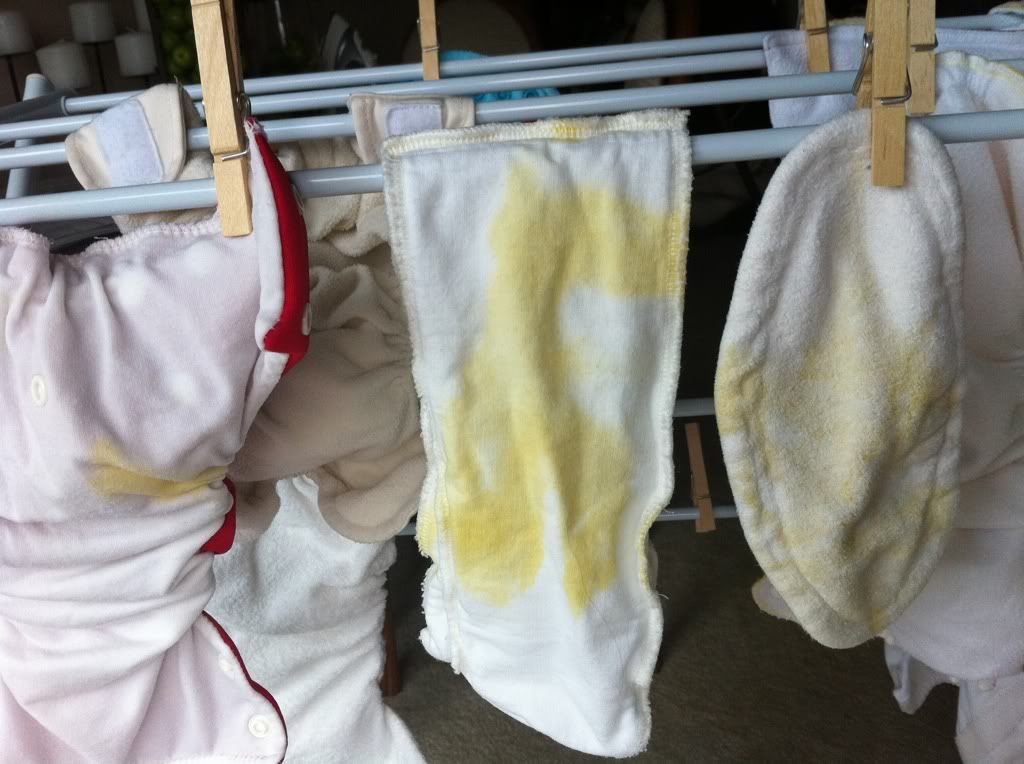
After just FIVE minutes in the sun:
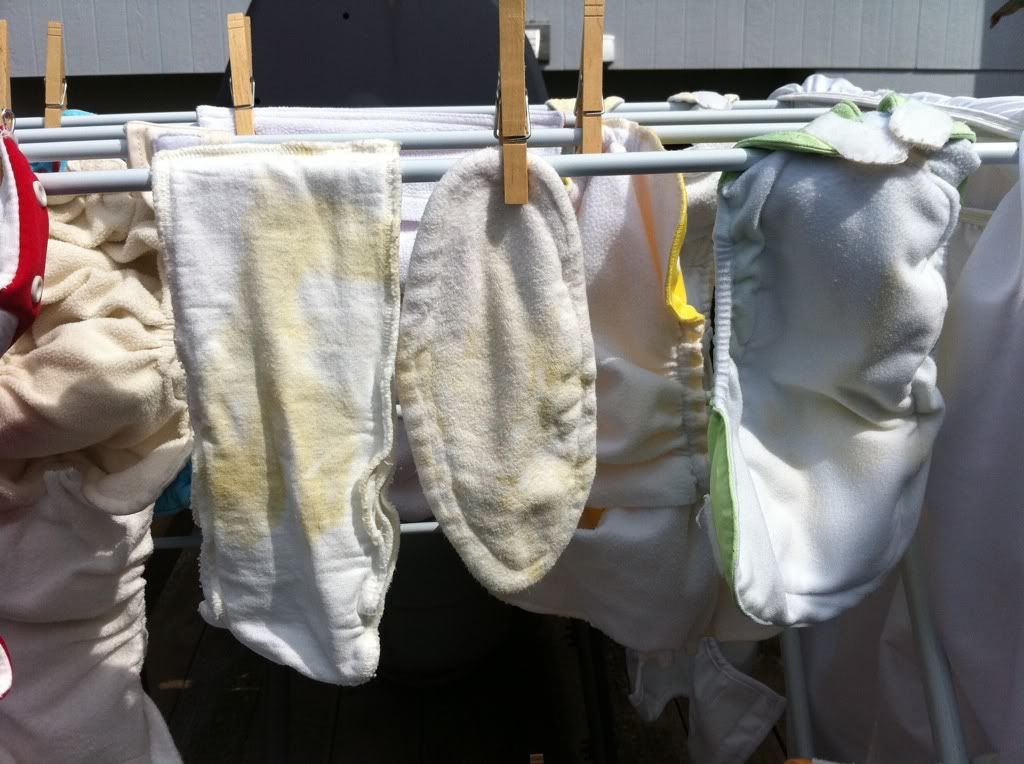
After twenty minutes, they are nearly completely gone:
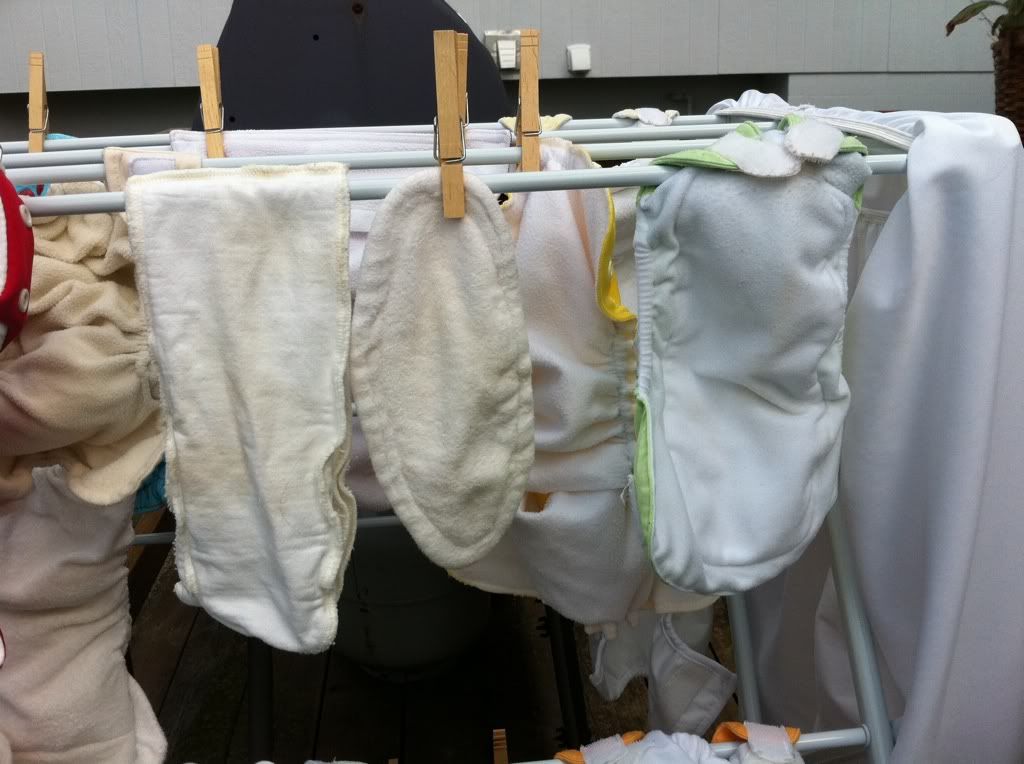
And after half an hour, they are completely gone!
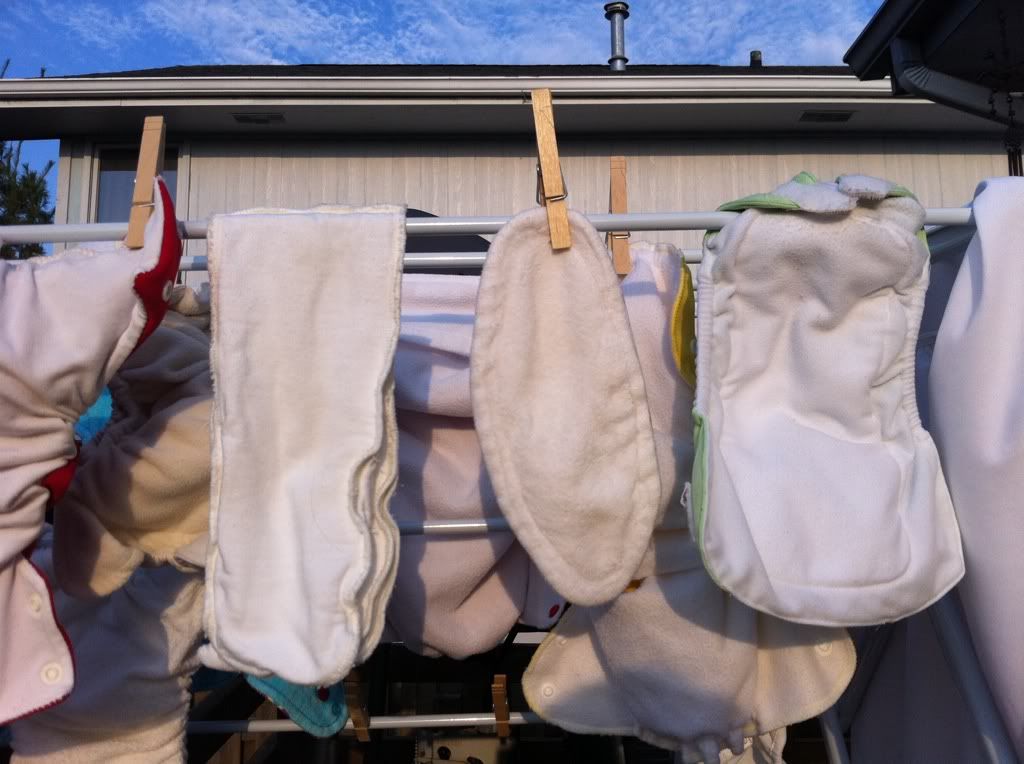
MAGIC!
Subscribe to:
Posts (Atom)